Should I consider an injection instead of surgery?
Treatments
Injections
Injections can play a role in managing knee pain and osteoarthritis, either to delay surgery or to support patients who are not yet ready for it. Not all injections are equal — below are my thoughts on each option, the evidence behind them, and the treatment and rehabilitation programmes I use.
Steroid injections
Steroids — my thoughts
I rarely offer steroid injections. While they can provide short-term pain relief by reducing inflammation, in my view the benefit is usually small and very short-lived, and it comes with a real downside to the cartilage in your knee.
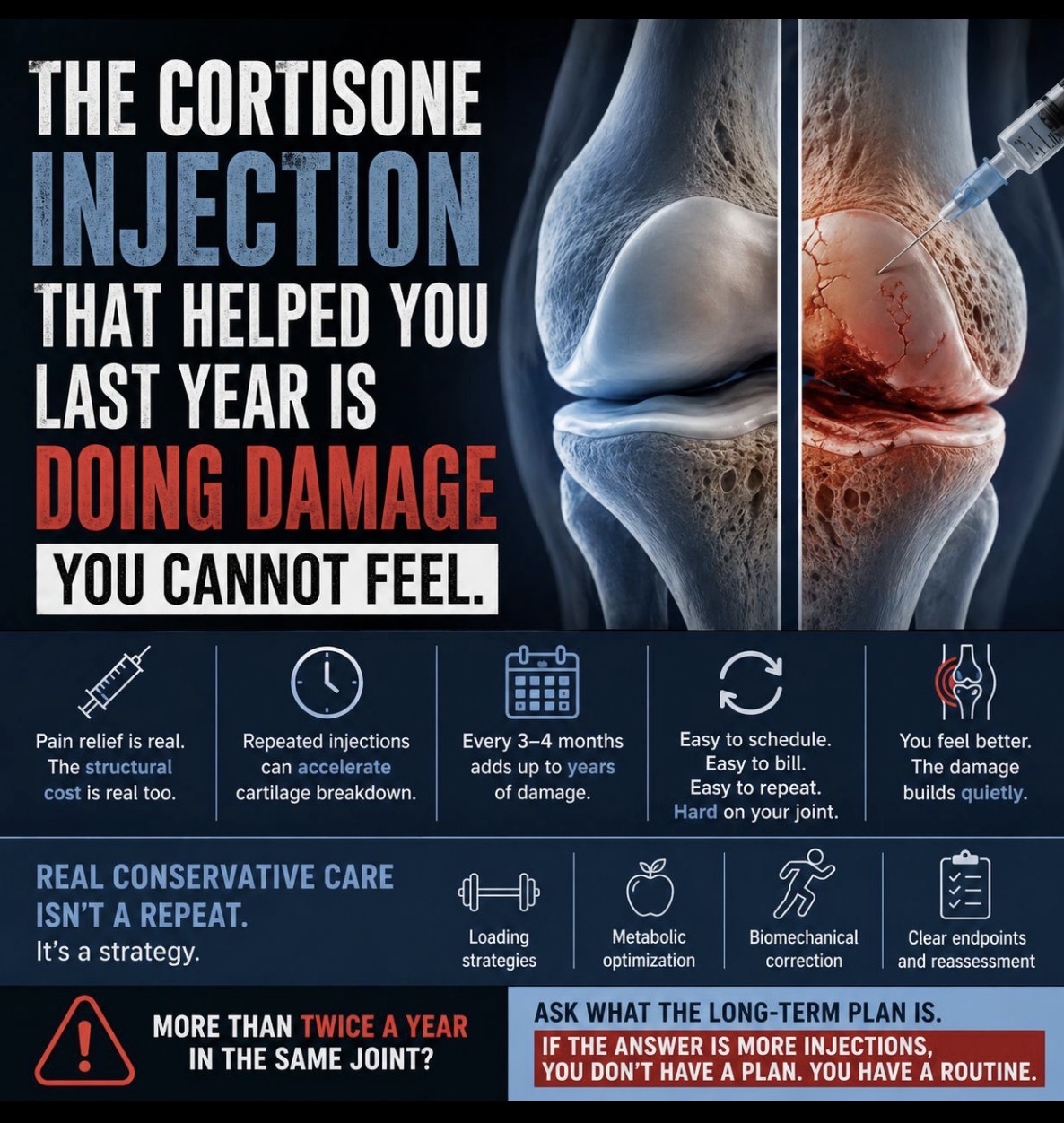
The evidence on chondrotoxicity is increasingly concerning. Laboratory studies have shown that corticosteroids are toxic to cartilage cells (chondrocytes), and clinical studies — including a well-known randomised controlled trial published in JAMA (McAlindon et al., 2017) — found that patients receiving repeated steroid injections over two years had significantly greater cartilage loss than those receiving saline, with no meaningful improvement in pain. More recent imaging studies have also linked steroid injections to accelerated progression of osteoarthritis.
For these reasons I prefer to reserve steroids for very specific situations and will always discuss the risks and the limited, short-term nature of any benefit with you first.
Ostenil
Ostenil (Hyaluronic Acid)
Ostenil is a hyaluronic acid injection — a gel-like substance that mimics the natural lubricating fluid in your knee joint. It is injected into the knee to help restore the joint's shock absorption and lubrication, with the aim of reducing pain and stiffness in osteoarthritis. It is sometimes called viscosupplementation.
The evidence for hyaluronic acid injections is mixed. Some studies and meta-analyses suggest a modest benefit in pain and function that can last several months, particularly in mild to moderate osteoarthritis, while others find little meaningful advantage over placebo. In my experience the benefit, when it occurs, tends to be modest and time-limited. I will discuss with you whether it is a reasonable option in your particular situation and how it compares with the alternatives.
Injection programme & rehabilitation
The course
3 injections
Typically a course of three injections given one week apart, performed in clinic under sterile conditions.
0 – 2 weeks
Relative rest
Rest the knee for 24–48 hours after each injection and avoid high-impact activity for the first couple of weeks. Mild soreness or swelling can occur and settles.
2 weeks +
Build up activity
Gradually return to normal activity and continue a guided thigh muscle strengthening programme. Any benefit typically develops over the following weeks.
12 weeks
Follow-up & review
Review at around 12 weeks to assess response and plan further management if needed.
Arthrosamid
Arthrosamid
Arthrosamid is a non-biodegradable hydrogel (polyacrylamide) injection for knee osteoarthritis. Rather than wearing off after a few weeks like many injections, it integrates with the lining of the joint (the synovium) and acts as a long-lasting cushion.
The evidence is encouraging. Clinical trials and registry data have shown meaningful and durable improvements in pain and function lasting well beyond a year from a single injection, with a good safety profile. It can be a particularly useful option for patients who want to delay or avoid joint replacement surgery.
Injection programme & rehabilitation
The injection
Single injection
A single injection given in clinic under sterile conditions.
0 – 2 weeks
Settle & ease back
Rest the knee for 24–48 hours and avoid high-impact activity for the first two weeks. Some mild swelling or discomfort is normal and settles.
2 weeks +
Build up activity
Gradually return to normal activity and continue thigh muscle strengthening. The benefit builds over the following weeks and is often long lasting.
12 weeks
Follow-up & review
12 weeks + is the time it sometimes takes to see any major benefits. Follow up appointment at 12 weeks.
PRP
PRP (Platelet-Rich Plasma)
PRP uses a small sample of your own blood, which is spun in a centrifuge to concentrate the platelets and the growth factors they contain. This concentrate is then injected into the knee with the aim of reducing inflammation and supporting the joint environment.
The evidence for PRP in mild to moderate knee osteoarthritis is reasonably supportive. Several randomised trials and meta-analyses suggest PRP can improve pain and function more than hyaluronic acid or steroid in the right patients, with effects lasting up to around a year. Because it uses your own blood, the safety profile is good. Results do vary between individuals and preparation methods.
Injection programme & rehabilitation
The course
1–3 injections
Typically a course of one to three injections spaced a few weeks apart, prepared from your own blood on the day in clinic. My preference is to use a single injection preparation which has shown up to 80% success rates.
0 – 2 weeks
Relative rest
Avoid anti-inflammatory medication around the injections, and avoid high-impact activity for the first couple of weeks. Mild soreness is expected.
2 weeks +
Strengthen & return
Resume normal activity gradually with a guided thigh strengthening programme. Benefit typically develops over several weeks.
12 weeks
Follow-up & review
12 weeks + is the time it sometimes takes to see any major benefits. Follow up appointment at 12 weeks.
BMAC
BMAC (Bone Marrow Aspirate Concentrate)
BMAC is harvested from your own bone marrow, usually from the pelvis (iliac crest), and concentrated to provide a rich source of stem cells and growth factors. It is injected into the knee to support the cartilage and joint environment, and is generally considered for patients with more advanced cartilage damage.
The evidence is earlier-stage than for Arthrosamid or PRP but promising. Studies report improvements in pain and function in knee osteoarthritis and as an adjunct to cartilage repair surgery, with a good safety profile as it uses your own cells. The quality of the evidence is still evolving and I will discuss realistic expectations with you.
Injection programme & rehabilitation
The procedure
Harvest & inject
Bone marrow is taken from the pelvis, concentrated and injected into the knee in a single day procedure, usually under local anaesthetic with image guidance.
0 – 2 weeks
Protect & recover
Rest both the knee and harvest site for the first few days and avoid high-impact activity for two weeks. Avoid anti-inflammatory medication around the procedure.
2 weeks +
Graduated rehab
Progress through a structured physiotherapy and thigh strengthening programme, building activity gradually as the benefit develops over the following months.
12 weeks
Follow-up & review
12 weeks + is the time it sometimes takes to see any major benefits. Follow up appointment at 12 weeks.
Risks
Risks of knee injections
- Infection — any injection carries a small risk of introducing infection into the joint.
- Bleeding — minor bleeding or bruising at the injection site can occur.
- Nerve damage — very rarely, a nerve near the injection site can be irritated or injured.
- No benefit — not everyone responds to injections; in some cases there may be little or no improvement in symptoms.
- Chondral damage (steroids) — corticosteroids have been shown to be toxic to cartilage cells and may accelerate cartilage loss.
- Further surgical treatment — an injection does not always prevent the need for surgery in the future.
- Loss of diabetic control (steroids) — steroid injections can cause a temporary rise in blood sugar, which may be significant for people with diabetes.